9-ME-BC
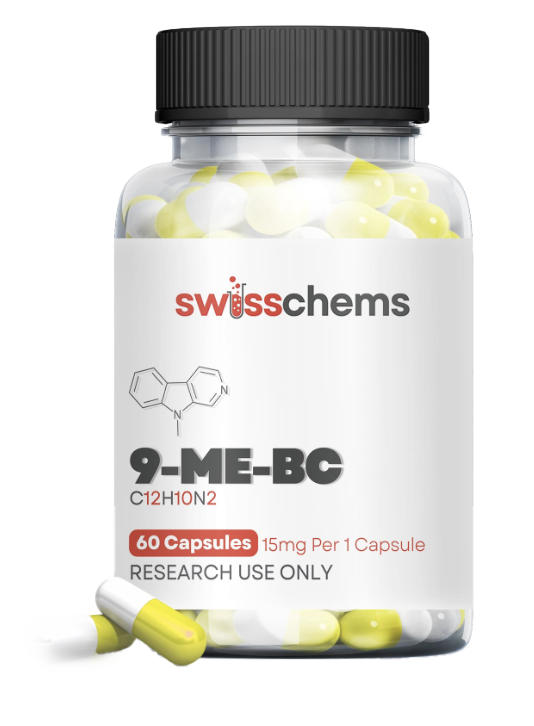
9-Me-BC is a synthetic β-carboline compound that is most often discussed online for its effects on dopamine systems. In preclinical research, β-carbolines have been shown to interact with monoamine pathways, including dopaminergic signaling, and some compounds in this class exhibit MAO-inhibiting properties or influence dopaminergic neuron function. Because of this, 9-Me-BC is sometimes promoted in nootropic or biohacking circles for motivation, focus, or “dopamine restoration.” It is not an approved medication, and products sold online fall squarely into research-chemical territory, with all the associated risks around purity, dosing accuracy, and long-term safety unknowns.
Mechanistically, the appeal of 9-Me-BC for some people is the idea that it may enhance or normalize dopaminergic tone. However, this is also why it can be risky: dopamine systems are tightly linked to motivation, reward, libido, emotional salience, and stress reactivity—all domains that are already fragile or dysregulated in many people with PFS/PSSD/PAS. Unlike symptom-targeted tools (e.g., blood-flow support), 9-Me-BC represents a direct CNS-active intervention that can push core neurotransmitter systems in unpredictable ways.
Anecdotes (Community Reports):
https://www.reddit.com/r/anhedonia/comments/tkkgqp/my_recovery_story/
https://pssdforum.org/viewtopic.php?t=3667
How to Interpret This Page
This page summarizes anecdotal reports and community observations, not medical evidence. “Risk” here refers to how frequently severe or prolonged symptom worsening is reported, not to proven causation or population-wide probability. Individual responses vary widely, and absence of issues in some users does not rule out significant reactions in others.
Community Reports: Mixed Outcomes & Variable Risk Signal
Overall pattern: In PFS/PSSD/PAS discussions, 9-Me-BC is described with high variability but a concerning downside signal. A minority of people report short-term benefits (e.g., increased motivation, mental clarity, or libido responsiveness), but many report no lasting benefit, and a notable subset describe clear worsening.
Reported worsening themes include increased anxiety or agitation, emotional blunting or flattening, insomnia, anhedonia, cognitive overstimulation followed by crashes, and a general sense of nervous-system destabilization. Some describe feeling briefly “upregulated” followed by a lower baseline once the compound is stopped. Because many of these reports involve delayed or persistent worsening, 9-Me-BC is often grouped with other high-risk dopaminergic/monoaminergic experiments rather than low-impact supplements.
Why this may matter mechanistically: Dopamine systems do not operate in isolation—they interact with serotonin, stress hormones, and neurosteroid/GABA signaling. In a sensitized system, pushing dopaminergic tone can amplify instability rather than restore balance, especially if underlying receptor regulation or downstream signaling is already altered. While some individuals tolerate or even benefit from dopaminergic agents, community reports suggest that for many with PFS/PSSD/PAS, the risk–reward balance skews negative.
Practical Caution Signal
9-Me-BC is best characterized as a high-uncertainty, CNS-active research chemical. Even where benefits are reported, they are inconsistent and often transient, while reports of worsening are frequent enough to warrant strong caution. Because sourcing is unregulated and long-term human safety data are lacking, many in the community advise avoiding 9-Me-BC altogether, especially during stabilization or recovery attempts.
Evidence Basis
Preclinical literature on β-carbolines and dopaminergic/monoamine systems; general neuropharmacology of dopamine and MAO-related compounds; anecdotal community reports (online forums, self-reports). No controlled human studies establishing safety or efficacy for PFS/PSSD/PAS.