NSI-189 (Amdiglurax)
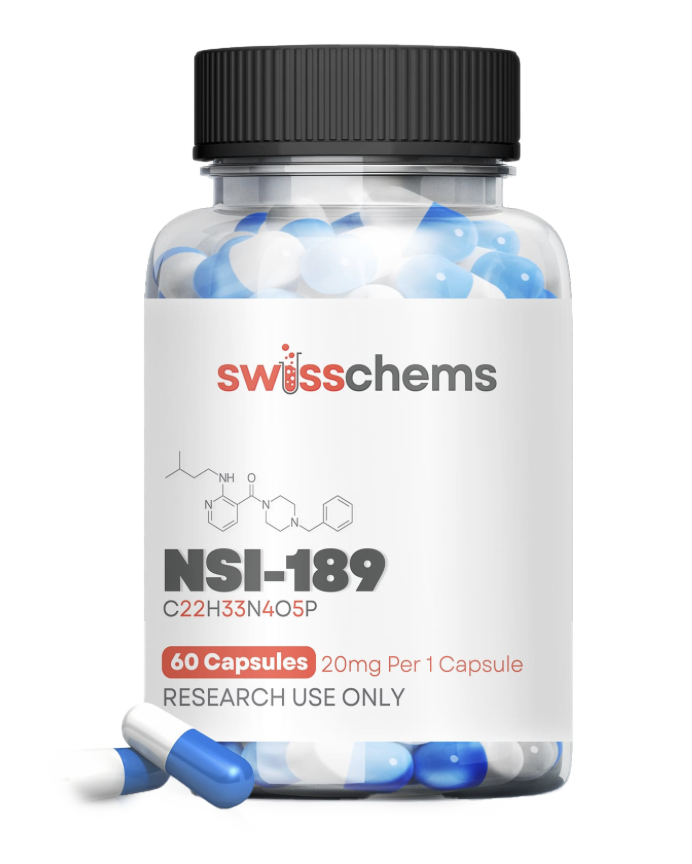
NSI-189 (often sold online as NSI-189 phosphate) is an investigational antidepressant candidate that has been studied in humans for major depressive disorder (MDD). It’s frequently discussed as a “neurogenic” or pro-neuroplasticity compound because it was discovered via screening approaches tied to hippocampus-related neural stem cell models and was developed around potential procognitive/brain-function effects rather than classic SSRI branding. Importantly, it is not an approved medication, and any product obtained outside regulated pharmaceutical channels should be treated as a research-chemical exposure with uncertain purity, dose accuracy, and contamination/adulteration risk.
Mechanistically, published clinical descriptions frame NSI-189 as “independent of serotonin or norepinephrine reuptake inhibition” (i.e., not an SSRI/SNRI-style monoamine reuptake blocker). (PMC) That said, the exact biological targets and downstream pathways responsible for any benefits remain not fully defined in mainstream sources—so it’s safest to describe it as a novel compound with a neurogenic/neuroplasticity-oriented development rationale rather than claiming transporter effects that aren’t established.
Anecdotes (Community Reports):
https://www.pssdforum.org/viewtopic.php?t=4429
https://www.pssdforum.org/viewtopic.php?t=5348
https://www.reddit.com/r/PSSD/comments/1jlun0v/anyone_else_trying_nsi189/
How to Interpret This Page
This page summarizes community anecdotes and informal observations, not medical evidence. “Improvement” means a person reported feeling better after an intervention; it does not prove the intervention caused the change or that it will apply to others. Outcomes are often influenced by multiple variables (time, stopping another trigger, dose changes, adjunct medications, sleep/diet, and baseline health), and reporting bias is common. Some interventions described in improvement stories are also associated with flares or worsening in other reports. Use this page as a starting point for research and discussion with a licensed clinician—not as medical advice.
Reported Improvement Mentions vs. Reported Risks
Across self-reports, NSI-189 has a mixed pattern: a small number of people describe large improvements (including occasional “full recovery/cure” claims), many report little to no change, and some describe worsening or destabilization (often framed around anxiety/agitation, sleep disruption, emotional blunting, or “feeling off”). Separately from anecdotes, the real-world caution is that NSI-189 is not an approved therapy and human trials were in MDD—not PFS/PSSD/PAS—so both the expected benefit and risk profile are uncertain in this population. If someone is considering it anyway, the biggest non-obvious risk is the supply chain: “research chemical” sourcing adds contamination/mislabelling risk on top of the drug’s inherent CNS effects. (DrugBank)
Evidence basis: Human clinical trials in MDD with mixed outcomes; established pharmacology framing as a novel neurogenic/pro-plasticity approach; anecdotal reports (online forums/self-reports). No controlled studies demonstrating benefit for PFS/PSSD/PAS specifically. (Nature)
Community Reports: Mixed Outcomes & Variable Risk Signal (NSI-189–specific)
Among individuals who already have PFS/PSSD/PAS, NSI-189 is generally discussed as high-uncertainty: the upside stories exist (and are part of why it keeps coming up), but they’re not the dominant outcome, and there are enough “no effect” and “felt worse” reports that most readers should treat it as a non-trivial gamble rather than a likely fix. The practical caution signal is that any strong CNS-active compound can be destabilizing in a sensitized system—and with NSI-189 specifically, the unregulated sourcing risk can turn a “trial” into an unknowable exposure.
*informational — not medical advice.
Summarizes community reports; not a recommendation to try or avoid